

Samsung Washer Repair in Madison, CT
Madison's moderately hard groundwater and periodic power disruptions from coastal weather patterns can accelerate mineral buildup and electrical stress in Samsung washers, making timely repair essential to avoid water damage and premature component failure. Madison Appliance Service connects you with local independent repair providers who serve neighborhoods across Madison, from North Madison to Middle Beach, and can often reach your home quickly when your washer stops working. A fast local repair keeps your laundry routine on track and protects your home from the water-related risks that come with delayed service.

Samsung Washer Repair for Madison, CT Homeowners
Homeowners throughout Madison depend on reliable laundry appliances, and Samsung washers are common in local households. The groundwater in this part of Connecticut tends toward moderate hardness, which can accelerate mineral buildup inside washers and affect their performance over time. When a Samsung washer begins to leak, cycle improperly, or drain slowly, the issue often traces back to sediment accumulation or component wear that requires prompt attention. Quick access to a repair technician can mean the difference between a minor fix and water damage to your laundry area, making local repair resources essential for Madison residents.
Madison Appliance Service connects property owners with independent local repair providers who diagnose and repair Samsung washers throughout Madison. The providers in this network respond to calls from homeowners in areas including North Madison and Middle Beach, arriving with the tools and knowledge to address common Samsung washer faults—from inlet valve problems to drum seal issues. Rather than guessing at the problem or attempting risky DIY fixes, you get a straightforward assessment and transparent repair plan. After the work is complete, the independent provider will walk you through any maintenance steps that help extend your washer's lifespan, so you can move forward with confidence in your laundry routine.
Common Samsung Washer Error Codes
Not every code means a repair bill. Seven of these twelve Samsung washer codes are usually something you can clear yourself; the remaining five involve a part inside the unit.
Samsung Washer 4C
Often clearable without a technician
What it means: The washer asked for water and did not get what it expected, so it has stopped rather than run a cycle dry. Samsung shows this as 4C on newer panels, 4E on older ones and nF on some models — one fault, three displays.
Why it happens: Almost always something before the machine rather than inside it: a supply tap not fully open, a kinked fill hose behind the unit, or the small mesh screens where the hoses meet the washer silted up with scale and grit.
What you can check: Check both taps are fully open, then pull the machine out far enough to see the fill hoses are not kinked. If that looks fine, turn the taps off, unscrew the hoses at the machine end and look at the inlet screens for debris.
When to call someone: If the supply is good and the screens are clear, the inlet valve on the machine is next, and that is where it stops being an owner check.
Samsung Washer Ub
Often clearable without a technician
What it means: The load has gone off balance in the tub and the washer will not spin it at speed, because an unbalanced drum at spin speed can damage the machine.
Why it happens: Usually one heavy item on its own — a towel, a bath mat, a single pair of jeans — or a load that has twisted into a rope on one side of the drum.
What you can check: Open the door, redistribute the load by hand and restart the spin. Adding a couple of similar-weight items often settles it; washing one heavy item alone rarely spins well.
When to call someone: If it trips on every load including well-balanced ones, the suspension or the sensor reading the drum may need looking at.
Samsung Washer 4E
Often clearable without a technician
What it means: The same not-filling fault as 4C, shown as 4E on older Samsung panels.
Why it happens: A closed or partly closed tap, a kinked fill hose, or blocked inlet screens where the hoses connect.
What you can check: Work from the wall in: taps fully open, hoses unkinked, then the inlet screens at the machine end.
When to call someone: If water reaches the machine freely and it still will not fill, the inlet valve needs testing.
Samsung Washer SE
Often clearable without a technician
What it means: Water is not leaving the machine at the rate the cycle expects, or is not leaving at all. Shown as 5E, SE, 5C or nd depending on the panel.
Why it happens: The debris filter at the bottom front catches coins, hair grips and lint and eventually packs solid. A kinked drain hose or a standpipe that cannot take the flow does the same thing from further down the line.
What you can check: Open the small flap at the bottom front, drain the residual water into a tray and clean the filter. Then check the drain hose behind the machine for kinks and that it is not pushed too far into the standpipe.
When to call someone: If the filter is clean and the hose run is clear, the drain pump itself needs testing.
Samsung Washer UE
Often clearable without a technician
What it means: The same unbalanced-load condition as Ub, shown as UE on some Samsung models.
Why it happens: A single heavy item, or a load that has bunched to one side of the drum.
What you can check: Redistribute the load by hand and restart the spin.
When to call someone: If balanced loads also trip it, the drum suspension is worth checking.
Samsung Washer dC
Often clearable without a technician
What it means: The washer cannot confirm the door is shut and locked, so it will not start or will stop mid-cycle.
Why it happens: Most often laundry caught in the door seal stopping it closing flush, or a door that has been slammed rather than pushed shut.
What you can check: Open the door fully, clear anything caught around the seal, and close it firmly without forcing it. Check the latch and the strike plate for anything obstructing them.
When to call someone: If nothing is obstructing it and the lock still will not engage, the door lock assembly is the usual cause.
Samsung Washer SUd
Often clearable without a technician
What it means: The washer has detected far more foam than the drum is designed to handle, and is pausing to clear it before continuing.
Why it happens: Usually too much detergent, or a standard detergent used in a high-efficiency machine, which foams several times more than an HE formula.
What you can check: Let the machine run its own suds-clearing routine rather than cutting the cycle short. Next load, reduce the dose and check the detergent is HE-rated if your machine needs one.
When to call someone: If it appears with a correct HE dose, something may be holding water in the drum and it is worth having checked.
Samsung Washer 5C
Often clearable without a technician
What it means: The same not-draining fault as 5E and SE, shown as 5C on some Samsung panels.
Why it happens: A packed debris filter at the bottom front, a kinked drain hose, or a standpipe that cannot take the flow.
What you can check: Clean the filter behind the flap at the bottom front, draining the residual water into a tray first, then check the hose run behind the machine.
When to call someone: If the filter is clean and the hose is clear, the drain pump needs testing.
Samsung Washer nF
Often clearable without a technician
What it means: The washer is not filling — the same fault Samsung shows as 4C and 4E on other panels.
Why it happens: A tap that is not fully open, a kinked fill hose, or the inlet screens where the hoses meet the machine blocked with scale and grit.
What you can check: Check both taps, straighten the hoses, then turn the taps off and inspect the inlet screens at the machine end.
When to call someone: If water reaches the machine freely and it still will not fill, the inlet valve is next.
Samsung Washer OE
Usually needs a technician
What it means: There is more water in the tub than there should be, so the washer has stopped filling and is trying to pump out.
Why it happens: Normally the inlet valve passing water when it has been told to close, rather than anything to do with the load or detergent.
What you can check: Turn the supply taps off at the wall so no more water can arrive. There is no owner-side fix for a valve that will not shut.
When to call someone: Promptly — a valve stuck open is a flood risk as well as an error code.
Samsung Washer 0E
Usually needs a technician
What it means: The same overfill condition as OE, shown with a zero on some panels.
Why it happens: An inlet valve letting water through when it should be closed.
What you can check: Shut the taps at the wall to stop the fill. Nothing else here is an owner check.
When to call someone: Promptly, for the same reason as OE.
Samsung Washer ddC
Often clearable without a technician
What it means: The AddWash door — the small hatch in the main door — is not registering as closed and latched.
Why it happens: It is easy to push shut without seating the catch, and a trapped sock or glove will stop it closing flush.
What you can check: Open the AddWash door fully, clear anything caught in it, and press it closed until the catch engages.
When to call someone: If it is properly shut and still reads open, the hatch switch needs checking.
Samsung Washer HE
Usually needs a technician
What it means: A fault in the heater circuit, so the machine cannot bring the wash water up to the temperature the cycle asked for.
Why it happens: A component failure rather than anything that builds up, so it usually appears without warning.
What you can check: Nothing here is an owner check — the heater and its circuit are inside the machine.
When to call someone: When you see it. Cold-water cycles may still run, but the machine is not doing what the programme selected.
Samsung Washer 5E
Often clearable without a technician
What it means: The same not-draining fault Samsung shows as SE and 5C on other panels.
Why it happens: A packed debris filter at the bottom front, a kinked drain hose, or a standpipe that cannot take the flow.
What you can check: Open the flap at the bottom front, drain the residual water into a tray and clean the filter, then check the hose run.
When to call someone: If the filter and hose are clear and it still will not drain, the drain pump needs testing.
Samsung Washer LE
Usually needs a technician
What it means: Moisture has been found somewhere inside the machine it should not be — a leak, not a setting.
Why it happens: Water escaping from a hose connection, a seal or the tub reaches a sensor that shuts the cycle down.
What you can check: Turn the supply taps off at the wall and stop using the machine. The code says water is escaping but not from where.
When to call someone: This needs a technician — tracing the source means getting behind or under the machine.
Samsung Washer 3E
Usually needs a technician
What it means: A motor fault — the drive is not behaving the way the control expects.
Why it happens: A failure in the motor or its control circuit rather than anything to do with the load or detergent.
What you can check: Nothing here is an owner check. A single power-cycle at the breaker clears a one-off glitch; a code that returns is real.
When to call someone: If it comes back after a power cycle, the motor circuit needs testing.
| Code | What it means |
|---|---|
| Ub / UE / U6 | The load is unbalanced inside the tub, so the washer cannot spin it safely. |
| 5E / SE / 5C / nd | Water is not draining at the rate it should, or is not draining at all. |
| dC / dC1 / dL | The door is not being detected as closed and locked, so the cycle will not run. |
| SUd / Sd | An over-sudsing condition has been detected and the machine is pausing to let the foam clear. |
| OE / 0E / OC | There is too much water in the washer, which normally means the inlet valve is passing water when it should be shut. |
| LE / 1C | Moisture has been detected somewhere inside the machine that it should not be, which is a leak rather than a setting. |
| HE / HC | A fault in the heater circuit, so the machine cannot bring the water up to temperature. |
| 3E / 3C | A motor fault — the drive is not behaving as the control expects. |
| tE / tC | The temperature sensor is reporting a reading outside the range the cycle allows. |
| bE2 / 6E2 | A button on the control panel is reading as stuck or continuously pressed. |
Don't see your code? Call (203) 437-4815 — we'll help you track it down.
Common Samsung Washer Problems We Fix
Won't Drain
A clogged drain filter, kinked hose, or pump failure often stops water from emptying. The independent provider you're connected with will inspect the drain path and repair or replace the blocked component.
Not Spinning
Worn drum bearings, a faulty lid switch, or motor issues can prevent the drum from turning. The local provider diagnosing your Samsung washing machine repair will test the motor and bearing assembly to identify the cause.
Leaking Water
Loose hose connections, a damaged door seal, or internal tank cracks commonly cause leaks. The technician you're matched with will locate the source and seal or replace the leaking part.
Error Code on Display
Samsung washers show error codes like 4C for drainage problems or E2 for door lock issues. The provider will decode the message and repair the underlying fault—whether electrical, mechanical, or plumbing-related.
Loud or Vibrating
Foreign objects caught between the drum and tub, worn drum rollers, or an unbalanced load create noise and shake. Samsung washer service from the provider you're connected to includes inspection and replacement of worn suspension parts.
Won't Start or Fill
Water inlet valve failure, power issues, or control board problems prevent the cycle from beginning. The independent repair provider will test the inlet valve, electrical connections, and cycle control to restore operation.
Why Madison Homeowners Trust Local Samsung Washer Repair
Samsung Washer Repair From Local Experts
Madison Appliance Service connects you with independent local providers who know Samsung washers inside out. Fast response times mean less laundry pile-up and less disruption to your household routine.
Clear Communication Throughout Samsung Washer Repair
When your Samsung washer breaks down, you need straight answers about what's wrong and what it costs. Local providers explain the problem and your options in plain language before starting any work.
Thorough Samsung Washer Repair, Done Right
Quick fixes that fail again waste your time and money. Independent providers Madison Appliance Service connects you with diagnose the root cause of your Samsung washer issue and address it completely.
Samsung Washers & Hard Water Challenges
Madison's groundwater tends toward mineral hardness, which builds up inside Samsung washers over time and can damage drums and valves. Local providers understand this regional water chemistry and know how to service washers accordingly.
How Our Repair Service Works
Schedule Your Samsung Washer Repair Visit
Contact Madison Appliance Service to describe your Samsung washer issue—whether it's a drainage problem, drum malfunction, or cycle failure. We'll connect you with a local independent repair provider who can visit your Madison home quickly and assess what's wrong.
Diagnose Your Samsung Washer
The technician will inspect your Samsung washer, test its components, and identify the root cause of the malfunction. In Madison, water quality can affect washer performance over time; the technician will check for sediment buildup or mineral deposits that may be restricting water flow or affecting cycles.
Complete Your Samsung Washer Repair
Once the diagnosis is confirmed, the independent provider will explain repair options and proceed with fixing your Samsung washer—whether that involves replacing a valve, seal, motor, or control board. You'll receive follow-up guidance on maintenance to help your washer run reliably going forward.
Need appliance repair in Madison? Our technicians can help fast.
Call (203) 437-4815Samsung Washer Repair Across Madison
Properties throughout Madison face a common water-quality challenge that directly affects Samsung washers and similar appliances. Much of the area relies on private well water rather than a centralized municipal supply, and the groundwater here tends toward moderate hardness. Over time, mineral buildup inside wash drums, inlet valves, and hose connections can reduce performance, cause unexpected cycles to fail, or create drainage issues—problems that independent repair providers in the area encounter regularly on Samsung models.
Nor'easters and coastal storms bring periodic power interruptions across Madison, including neighborhoods like North Madison and East Wharf. When electricity cuts out and surges back on, the control boards and water-inlet solenoids in Samsung washers can take a hit. Sediment that stirs up in well systems during heavy weather can also clog fill lines and damage internal components. Homeowners who notice their Samsung washer acting erratic after a storm or power event should reach out to a local provider through Madison Appliance Service for prompt diagnosis and repair.
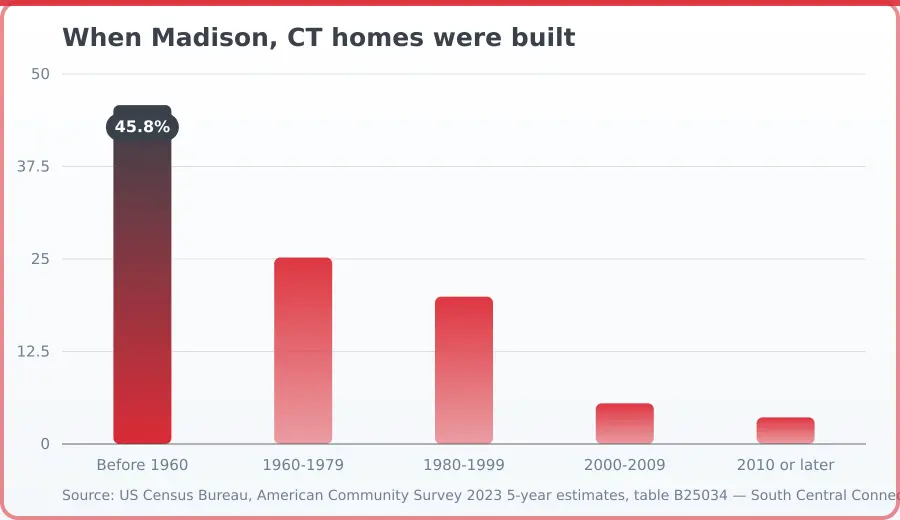
| Period | When homes were built (%) |
|---|---|
| Before 1960 | 45.8 |
| 1960-1979 | 25.2 |
| 1980-1999 | 19.9 |
| 2000-2009 | 5.5 |
| 2010 or later | 3.6 |
Source: US Census Bureau, American Community Survey 2023 5-year estimates, table B25034 — South Central Connecticut Planning Region (247,217 housing units; county figure, as this location is not a separate Census place). Retrieved November 10, 2026.
Samsung Washer Repair FAQ — Madison, CT
Samsung Washer Repair addresses issues like drum failures, water valve problems, drainage clogs, control board malfunctions, and seal leaks. The independent repair provider will diagnose the specific fault, source OEM or compatible parts, and perform the repair at your Madison home. Common jobs range from replacing inlet valves to addressing drum bearing wear.
Madison Appliance Service matches you with a local independent repair provider serving Madison, CT. Response times vary by provider availability, but local technicians in the area typically can schedule appointments within a few days. Call or submit your request to get connected to someone nearby who handles Samsung washers.
Repair costs depend on the fault diagnosis, the specific part needed, and labor time. A simple inlet valve replacement differs from drum bearing work. The independent provider will assess your Samsung washer and discuss pricing before proceeding. Call to describe the symptoms and get an estimate tailored to your situation.
Note when the problem started and what you observe—leaks, noise, cycle failures, or error codes. Empty the drum and clear any debris. If your Samsung washer won't drain, leave the door open to air it out. Provide clear access to the machine and mention any recent power interruptions or water changes so the technician has full context.
Clean the drum and rubber gasket regularly to prevent mold and buildup. Use the correct detergent amount and type for your model. Leave the door open between cycles to air-dry the interior. Run hot-water cleaning cycles periodically, and avoid overloading. These habits extend the life of seals, bearings, and valves.
Madison's private well water tends to be moderately hard, which can accelerate mineral buildup in inlet valves and supply lines. Over time, this sediment stress strains the washer's water-intake components and may trigger early wear. Regular cleaning cycles and inlet filter checks help offset this local water condition and protect your Samsung machine.
More Repairs for This Brand
Homeowner Safety Toolkit
Confirm Who You're Hiring in Madison, CT
Before you hire anyone, use these independent national resources to confirm credentials, standards, and track record.
ISCET
NASTeC is the appliance repair industry's own national certification exam, administered by the nonprofit ISCET. It's voluntary, so it's worth asking whether your technician holds it.
About NASTeC CertificationEPA
Anyone who services a refrigerator, freezer, or other appliance containing refrigerant is legally required to hold EPA Section 608 certification. See what that actually requires.
Refrigerant Certification RulesCPSC
Check whether your specific appliance has an open safety recall before paying for a repair — some recalls cover the fix or a replacement for free.
Check for RecallsBook your Madison appliance repair today.
Call (203) 437-4815Where We Cover Near Madison, Connecticut
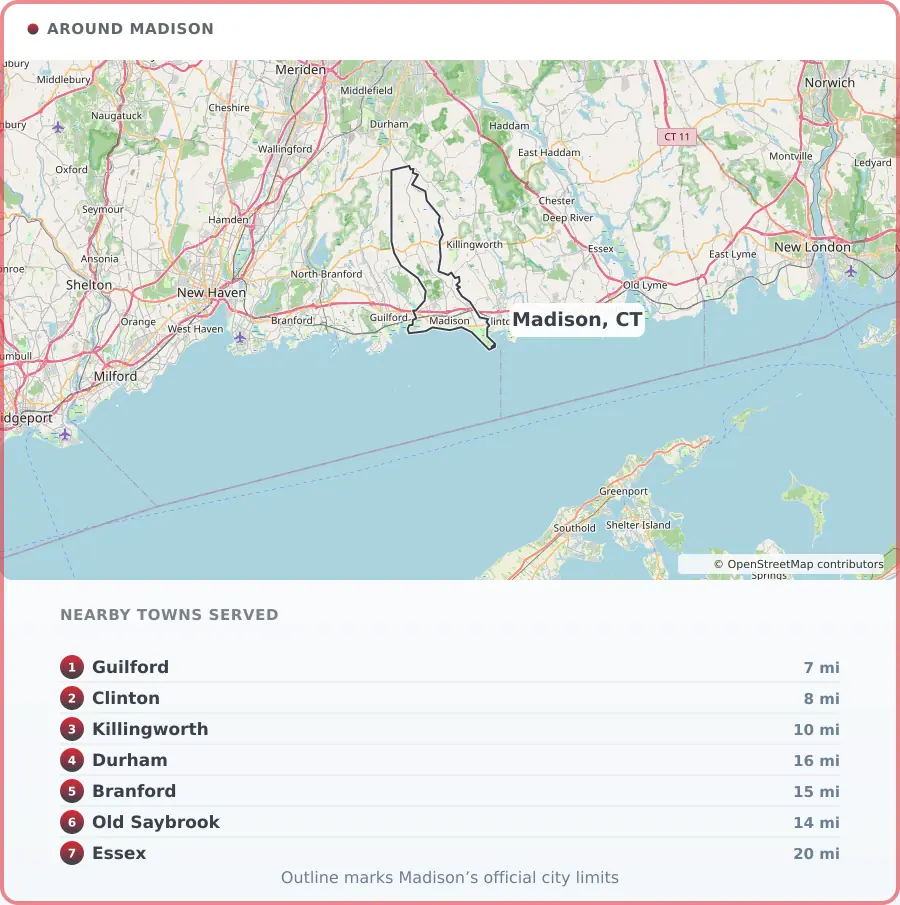
Coverage centres on Madison, CT and reaches 7 surrounding communities. Response time is what matters most in the hours after a problem is found, so knowing the ground is part of the job.
Madison, CT Information
Madison, Connecticut sits along the Long Island Sound shoreline, a town of roughly 18,000 that blends beach-town charm with quiet New England polish. Its economy leans heavily on tourism and small business, shaped by the seasonal pull of Hammonasset Beach State Park and a historic downtown anchored by shops like RJ Julia Booksellers. Many residents commute toward New Haven or Hartford, making Madison as much a bedroom community as a destination, with healthcare, education, and professional services rounding out local employment alongside the Town of Madison and Madison Public Schools.
From the East Wharf shoreline to the quieter inland stretches near North Madison, the town carries a relaxed, close-knit character year-round. Marine and boating services reflect its coastal rhythm, while institutions like Scranton Memorial Library and the Madison Beach Hotel give the community a steady, welcoming center beyond the summer crowds.

Photo: Léo Schmitt, CC BY-SA 4.0